

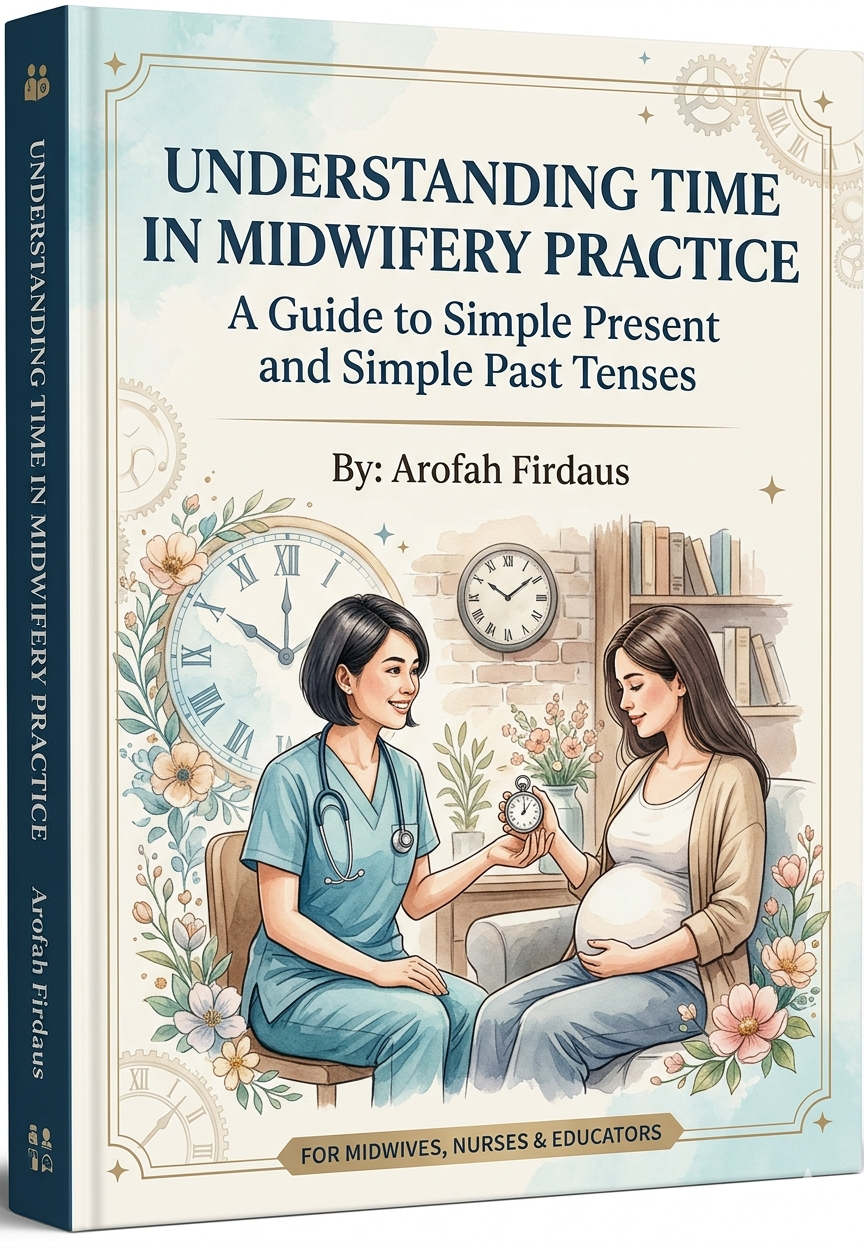
By: Arofah Firdaus
Introduction
In the world of midwifery, precision is not only about medical procedures but also about communication. A midwife needs not only to read fetal growth charts but also to write reports, interview patients, and read international journals. This is where tenses in English become crucial.
Two tenses that are most frequently used in midwifery contexts are the Simple Present Tense (for facts and routines) and the Simple Past Tense (for past events). This article will discuss both tenses practically, with real-life examples from midwifery practice.
A. Simple Present Tense: Eternal Truths and Daily Routines
1. What is Simple Present Tense?
The simple present tense is used to express:
- Scientific facts (general truths)
- Habits or routines (repeated actions)
- Fixed schedules (e.g., practice schedules, immunization schedules)
2. Basic Formula
Sentence Type Formula Example Positive S + V1 (s/es) + O A midwife examines pregnant women. Negative S + do/does + not + V1 Midwives do not ignore hygiene protocols. Interrogative Do/Does + S + V1? Does the baby cry frequently?
Note:
- He, she, it → use V1 + s/es
- I, you, we, they → use V1 (no s/es)
3. Examples in Midwifery Context
Fact: The normal gestational period lasts about 40 weeks.
Routine: A midwife takes the patient’s blood pressure every morning.
Schedule: The antenatal care session starts at 8 a.m. every Wednesday.
4. Common Time Signals
Always, usually, often, sometimes, rarely, never, every day/week/month.
B. Simple Past Tense: Caring for Past Stories
1. What is Simple Past Tense?
The simple past tense is used to express:
- Completed actions in the past (specific time is mentioned or understood)
- A sequence of past events (narration)
- Past habits (no longer happening now)
2. Basic Formula
Sentence Type Formula Example Positive S + V2 + O The patient gave birth last night. Negative S + did + not + V1 The baby did not cry after delivery. Interrogative Did + S + V1? Did the mother experience contractions?
Note:
- V2 (past form) can be regular (-ed) or irregular (go → went).
3. Examples in Midwifery Context
Completed action: The midwife assisted a home birth yesterday.
Narration: First, the mother felt a contraction. Then, her water broke.
Past habit: In the 1990s, midwives used fewer electronic monitors.
4. Common Time Signals
Yesterday, last night, last week, in 2020, two days ago, this morning (if already passed).
C. Quick Comparison: When to Use Which?
Aspect Simple Present Simple Past Time Present, general, routine Completed in the past Example sentence The baby sleeps 16 hours a day.The baby slept well last night. In a midwife’s report I write the patient’s history every day.I wrote the patient’s history yesterday.
D. Exercises
Complete the following exercises to test your understanding. Choose the correct verb form (Simple Present or Simple Past).
Exercise 1: Fill in the blanks with the correct verb form
- A midwife usually __ (check) the fetal heart rate every 30 minutes during active labor.
- Last Monday, the midwife __ (detect) an abnormal presentation.
- Pregnant women __ (need) at least 300 extra calories per day.
- The mother __ (not / feel) any movement yesterday evening.
- (do) the baby often (hiccup) in the womb?
Exercise 2: Change the following sentences from Simple Present to Simple Past
Example: The baby cries every night. → The baby cried last night.
- The midwife gives iron tablets to anemic patients. (add time signal: last week)
- I don’t see any signs of infection. (add: in the previous examination)
Exercise 3: Create two sentences of your own in a midwifery context**
- One sentence using Simple Present (fact/routine)
- One sentence using Simple Past (past event)
Closing
Mastering the simple present and simple past tenses is not just about grammar. For a midwife, these are tools to record facts, write reports, and understand global literature accurately. Keep practicing, because every sentence you write is part of quality professional care.
Happy learning and keep up your spirit!
Let me know if you would like a version with Indonesian-to-English glossaries or a PowerPoint format for teaching.


Tinggalkan Balasan