

Abstract
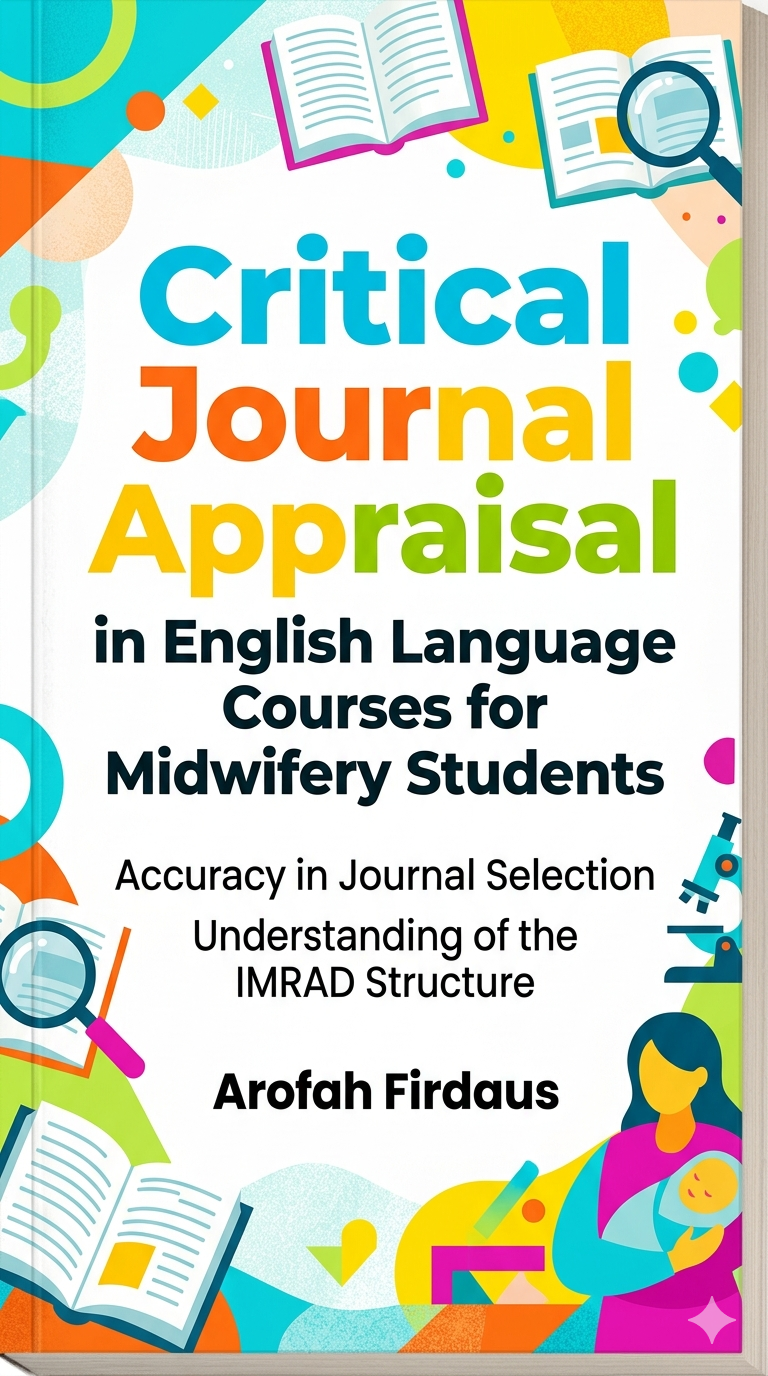
Critical journal appraisal is an essential competency for midwifery students in implementing evidence-based practice. This article aims to analyze two main aspects of journal appraisal in midwifery: accuracy in finding journals that align with the scientific field and comprehension of the IMRAD structure (Introduction, Methods, Results, and Discussion). The writing method employs a literature study with a descriptive analytical approach. The discussion reveals that students need to master search strategies in trusted databases such as PubMed, CINAHL, and Google Scholar using structured keywords (PICO). Understanding IMRAD goes beyond memorization; it includes identifying bias in the methods, the validity of results, and the relevance of the discussion to clinical midwifery practice. This article concludes that integrating journal search skills and IMRAD analysis improves the quality of critical appraisal among midwifery students.
Keywords: critical journal appraisal, midwifery, IMRAD, evidence-based practice, PICO
INTRODUCTION
In the midwifery program curriculum, English language courses are often perceived as focusing solely on grammar and general vocabulary. In fact, the main essence of learning English for midwives is to equip students with the ability to access, understand, and critically evaluate international scientific literature. The world of midwifery is rapidly evolving with new findings related to antenatal care, childbirth, postpartum care, newborns, and contraception. Most reputable journals are published in English. Therefore, critical journal appraisal skills serve as a bridge between classroom theory and evidence-based clinical practice.
A common challenge faced by midwifery students is inaccuracy in selecting journals—for instance, using predatory journals or articles that are not relevant to specific midwifery cases. Furthermore, many students can recite the acronym IMRAD but fail to grasp the critical essence of each section. This article will discuss practically and accessibly how to improve accuracy in finding journals and meaningfully understand IMRAD.
METHOD
This article was compiled using a narrative review approach by analyzing various critical appraisal guidelines from the Cochrane Collaboration, Joanna Briggs Institute (JBI), and indexed midwifery journals (Scopus Q1 and Q2). Secondary data were collected from articles published between 2019 and 2024. The analysis focused on two variables: journal search strategies relevant to midwifery and critical interpretation of IMRAD components.
RESULTS AND DISCUSSION
A. Accuracy in Finding Journals Relevant to the Midwifery Scientific Field
Accuracy does not merely mean finding an article with the keywords “midwifery” or “obstetric.” Accuracy encompasses three levels:
- Topic relevance: The journal must address specific midwifery issues, for example, “effect of delayed cord clamping on neonatal hematocrit levels in term infants,” rather than a general medical article without midwifery implications.
- Journal credibility: Students need to verify whether the journal is indexed in DOAJ, Scopus, or Web of Science. Avoid journals with fake impact factors or non-transparent peer review practices.
- Recency: For midwifery, articles published within the last 5–7 years are recommended, except for landmark studies.
Practical strategies:
- Use the PICO framework (Population, Intervention, Comparison, Outcome). Example: In pregnant women with anemia (P), does daily iron supplementation (I) compared to three times per week (C) more effectively increase hemoglobin levels (O)?
- Utilize Boolean operators (AND, OR, NOT) in PubMed. Example: (“pregnancy” OR “antenatal”) AND (“yoga” OR “physical exercise”) AND (“preterm birth” OR “premature labor”).
B. Understanding IMRAD in Midwifery Journal Articles
A critical understanding of IMRAD is not merely being able to point out which section is the Introduction or Methods. Below is a detailed critical appreciation of each component:
1. Introduction
- What to examine: Does the author clearly explain the research gap? Is the research question appropriate to current midwifery issues?
- Example of critical question: “Is the background explaining why this intervention is important for midwives in Indonesia adequately described?”
2. Methods
- This is the most vital part for detecting bias. Midwifery students must be able to assess:
- Research design: RCT, cohort, case-control, or cross-sectional? Is the design appropriate for the research question?
- Population and sample: Are inclusion and exclusion criteria clear? Was the sample size calculated correctly?
- Ethics: Is there ethical clearance and informed consent?
- For intervention studies: Was randomization and blinding performed?
- Common mistake: Students often overlook attrition bias (drop-out participants) in birth-related studies.
3. Results
- Critical focus: Are tables and graphs presented without excessive interpretation? Are effect sizes (RR, OR, mean difference) reported along with confidence intervals and p-values?
- Often overlooked: Do the authors report adverse events? For example, in a journal about labor induction, side effects for both mother and fetus must be transparent.
4. Discussion
- Do the authors compare their findings with previous research? Are limitations honestly acknowledged?
- Important for midwifery: Are the clinical implications realistic for midwifery practice in community or limited-resource health facilities?
Table 1. Example of Rapid IMRAD Appraisal in a Midwifery Journal
IMRAD Section, Critical Questions for Midwives, Example of Red Flag.
Introduction, Is this issue important for maternal and neonatal safety?, No data on maternal mortality rate (MMR) or neonatal mortality rate (NMR).
Methods, Do the research subjects represent patients in midwifery clinics?, Sample only from type A hospitals, excluding primary health centers.
Results, Are the results both statistically and clinically significant?, p < 0.05 but very small effect size (e.g., Hb difference of 0.1 g/dL).
Discussion, Do the authors recommend safe practice changes?, Recommending an intervention without strong evidence and without discussing cost or resources.
CONCLUSION AND RECOMMENDATIONS
Critical journal appraisal skills for midwifery students cannot be separated from proficiency in scientific English. Accuracy in finding journals requires systematic search strategies based on PICO and selection of reputable databases. Understanding IMRAD must shift from mere identification to critical analysis of potential bias, validity, and clinical applicability. Therefore, English language lecturers in midwifery programs are encouraged to integrate hands-on journal appraisal exercises (using real journals, not textbook excerpts) and use assessment rubrics that emphasize both aspects. Students are also advised to read at least one international midwifery journal article each week using the IMRAD critical question guide.
REFERENCES
Aromataris, E., & Munn, Z. (Eds.). (2020). JBI Manual for Evidence Synthesis. JBI. https://synthesismanual.jbi.global
Higgins, J. P. T., Thomas, J., Chandler, J., Cumpston, M., Li, T., Page, M. J., & Welch, V. A. (Eds.). (2023). Cochrane Handbook for Systematic Reviews of Interventions (Version 6.4). Cochrane.
Melnyk, B. M., & Fineout-Overholt, E. (2019). Evidence-Based Practice in Nursing & Healthcare: A Guide to Best Practice (5th ed.). Wolters Kluwer.
Polit, D. F., & Beck, C. T. (2021). Nursing Research: Generating and Assessing Evidence for Nursing Practice (11th ed.). Wolters Kluwer.
Sari, R. P., & Lestari, T. (2022). Critical appraisal skills of midwifery students in reviewing international journals. Jurnal Ilmiah Bidan, 10(2), 88–95.
World Health Organization. (2021). WHO guide for appraisal of clinical research in reproductive health. WHO Press.


Tinggalkan Balasan ke Syarifah aisyiah Batalkan balasan